 VectorGym
VG-Sketch
Sketch2SVG
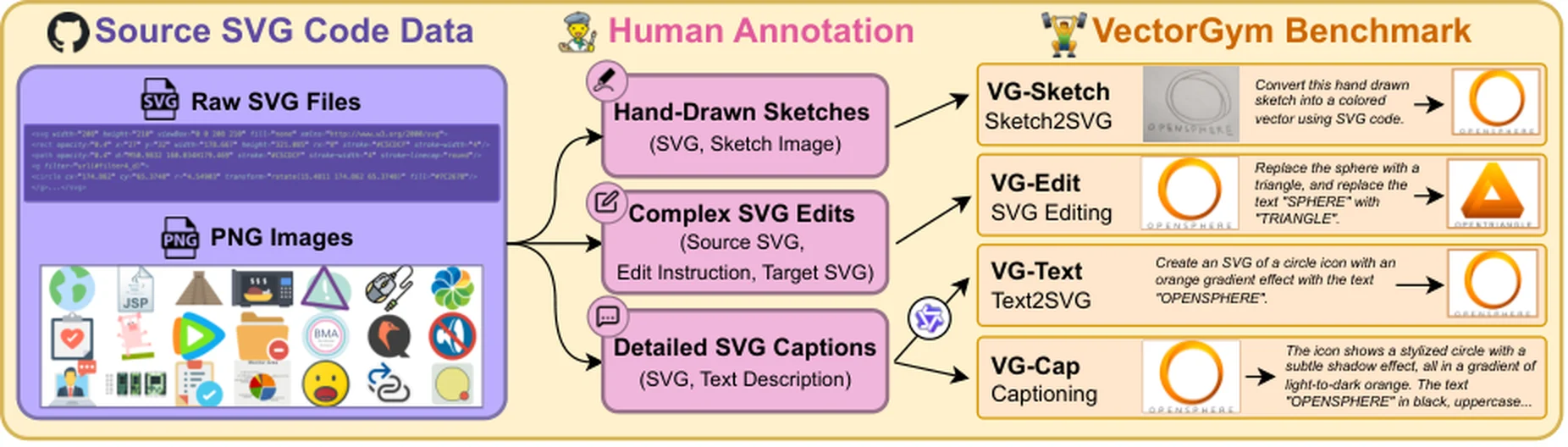
Convert a rough hand-drawn sketch into clean SVG code. Unlike image vectorization, the model must infer structure, topology and spatial relations from noisy, incomplete strokes. VectorGym introduces this task.
EMNLP 2026 · Benchmark
A Multi-Task Benchmark for SVG Code Generation, Sketching and Editing
Four tasks with expert human annotations: sketch-to-SVG generation, SVG editing, text-to-SVG generation and SVG captioning.
* Equal contribution.
01 · Tasks
An SVG is a program: its code specifies geometry, style and structure, and renders directly to an image. One benchmark can therefore assess visual fidelity, syntactic validity and structured manipulation together.
VG-Sketch
Convert a rough hand-drawn sketch into clean SVG code. Unlike image vectorization, the model must infer structure, topology and spatial relations from noisy, incomplete strokes. VectorGym introduces this task.
VG-Edit
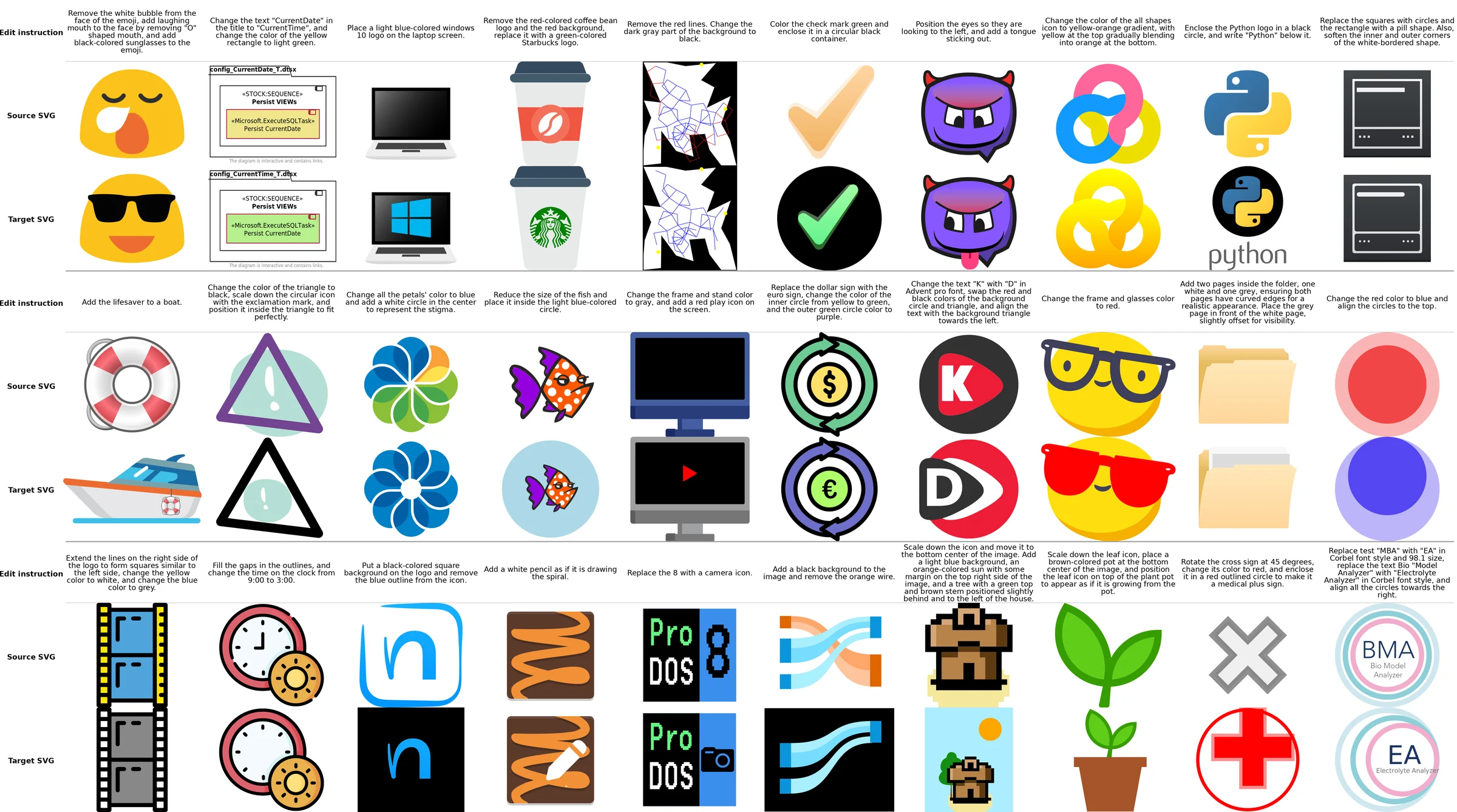
Apply a natural-language instruction to an existing SVG. The human-written edits require semantic understanding and several coordinated changes, such as adding objects, changing logo text, converting a pie chart to a bar chart or altering a facial expression, and often involve text, gradients or animation.
VG-Text
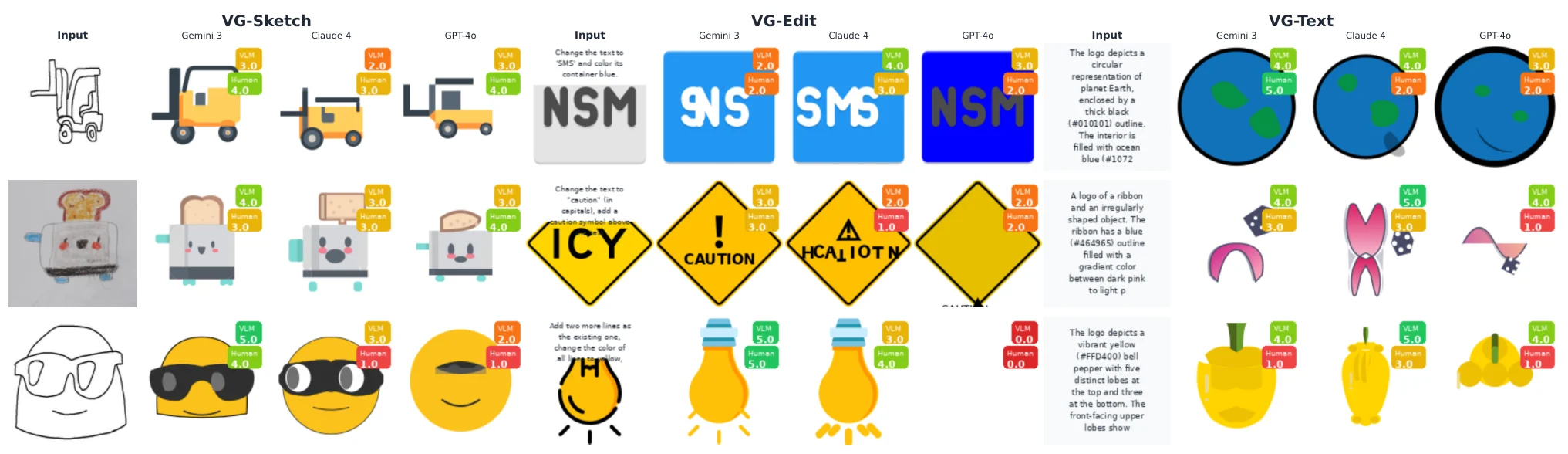
Generate a complete SVG from a text description, ranging from simple shapes to complex illustrations. Prompts are human-validated captions rewritten as instructions at several levels of detail.
VG-Cap
The inverse of Text2SVG: describe an SVG from its code, covering both its content and visual properties such as style and color scheme.
02 · Data
VectorGym draws on SVG-Stack, a collection of SVGs from GitHub that spans icons, diagrams, emojis, fonts, logotypes and complex illustrations and keeps their original primitives. More than 20 annotators from two vendors, with expertise in design, vector graphics and coding, created the sketches, edits and descriptions.
Filters retained SVGs of 2k to 8k tokens with normalized color entropy above 0.55; a random subsample was then inspected by hand.
| Dataset | SVG type | Samples | Multi-task | Primitives | Edits | Sketches | Human |
|---|---|---|---|---|---|---|---|
| SVGBench | In-the-wild | 10k | – | ✓ | – | – | – |
| VGBench | Emojis | 9.5k | ✓ | – | – | – | – |
| SVGEditBench | Emojis | 1.6k | – | – | ✓ | – | – |
| SVGEditBench V2 | Emojis | 1.6k | – | – | ✓ | – | – |
| UniSVG | Icons | 525k | ✓ | – | – | – | – |
| SVGenius | Icons | 100k | ✓ | – | ✓ | – | – |
| VectorGym | In-the-wild | 7k | ✓ | ✓ | ✓ | ✓ | ✓ |
03 · Method
The baseline fine-tunes Qwen3-VL 8B Instruct on all four tasks jointly with Reinforcement Learning from Rendering Feedback (RLRF), using the VectorGym training split.
For the three generation tasks, predicted and reference SVGs are rendered and compared with perceptual similarity and pixel-space distances. For captioning, the reward is the BGE-M3 embedding similarity between predicted and reference captions.
Standard GRPO normalizes rewards within each group of sampled responses. This variant divides the centered rewards by the standard deviation over the whole mini-batch:
\(K\) is the number of sampled responses per prompt and \(N\times K\) the number of samples in the mini-batch.
Response length is used as a proxy for difficulty. Samples are sorted by length within each task, and mini-batches draw tasks in proportion to their frequency, so training progresses from short to long examples with the tasks kept balanced.
04 · Results
The VectorGym score is the mean of four task scores (0 to 100). Gemini 3 Pro ranks first (73.17). The RL-trained Qwen3-VL 8B reaches 66.05, above GPT-4o (64.93) and the much larger Qwen3-VL 235B Instruct (62.32).
Proprietary Open-source RL baseline
Difficulty
Best VLM-judge scores are 93.00 for Text2SVG (GPT-5.1), and 81.20 for SVG editing, 72.20 for Sketch2SVG and 70.40 for SVG captioning (all Gemini 3 Pro).
Sketches
On Sketch2SVG, the open Qwen3-VL 235B and 8B Instruct models reach VLM-judge scores of 40.00 and 33.00. RL raises the 8B model to 46.00, well below Gemini 3 Pro (72.20). Models also rarely add colors absent from the sketch.
Captioning
The RL model achieves the highest BGE-M3 (79.76) and ROUGE (25.58) scores of all models, but a lower VLM-judge score (35.80) than Qwen3-VL 235B Instruct (40.40).
| Model | Sketch2SVG | SVG editing | ||||||||
|---|---|---|---|---|---|---|---|---|---|---|
| VLM J ↑ | MSE ↓ | DINO ↑ | LPIPS ↓ | Score ↑ | VLM J ↑ | MSE ↓ | DINO ↑ | LPIPS ↓ | Score ↑ | |
| Open-source | ||||||||||
| Qwen2.5-VL 72B Instruct | 12.80 | 16.43 | 69.87 | 43.95 | 55.57 | 16.60 | 18.68 | 70.35 | 38.21 | 57.52 |
| Qwen2.5-VL 32B Instruct | 17.80 | 15.15 | 71.63 | 42.65 | 57.91 | 20.20 | 17.04 | 72.31 | 37.05 | 59.61 |
| GLM-4.5V | 33.80 | 14.14 | 78.61 | 41.35 | 64.23 | 37.60 | 13.39 | 80.90 | 31.76 | 68.34 |
| Qwen3-VL 8B Instruct | 33.00 | 13.76 | 81.01 | 40.97 | 64.82 | 57.40 | 11.01 | 90.44 | 25.27 | 77.89 |
| Qwen3-VL 235B Instruct | 40.00 | 13.37 | 83.69 | 40.23 | 67.52 | 60.40 | 9.02 | 91.17 | 22.11 | 80.11 |
| Qwen3-VL 8B Gym (ours) | 46.00 | 11.99 | 88.25 | 39.37 | 70.72 | 67.00 | 8.36 | 93.94 | 21.34 | 82.81 |
| Proprietary | ||||||||||
| Gemini 2.5 Flash | 36.80 | 13.67 | 79.13 | 40.45 | 65.45 | 65.80 | 9.98 | 90.54 | 21.16 | 81.30 |
| GPT-4o | 46.00 | 13.17 | 85.11 | 39.74 | 69.55 | 66.80 | 8.43 | 92.27 | 21.24 | 82.35 |
| Claude Sonnet 4.5 | 58.80 | 12.54 | 88.42 | 39.29 | 73.85 | 79.40 | 6.29 | 95.61 | 16.46 | 88.07 |
| GPT-5.1 | 64.00 | 12.28 | 89.47 | 38.42 | 75.69 | 78.00 | 5.92 | 95.59 | 16.83 | 87.71 |
| Gemini 3 Pro | 72.20 | 11.31 | 89.78 | 36.43 | 78.56 | 81.20 | 5.89 | 95.55 | 16.01 | 88.71 |
| Model | Text2SVG | SVG captioning | ||||||
|---|---|---|---|---|---|---|---|---|
| VLM J ↑ | CLIP ↑ | DINO ↑ | Score ↑ | VLM J ↑ | BGE-M3 ↑ | ROUGE ↑ | Score ↑ | |
| Open-source | ||||||||
| Qwen2.5-VL 72B Instruct | 25.80 | 25.78 | 71.00 | 40.86 | 9.60 | 52.08 | 7.70 | 23.13 |
| Qwen3-VL 8B Instruct | 55.20 | 29.48 | 81.71 | 55.46 | 25.20 | 66.27 | 18.87 | 36.78 |
| GLM-4.5V | 59.40 | 28.91 | 80.44 | 56.25 | 38.00 | 62.85 | 16.86 | 39.24 |
| Qwen2.5-VL 32B Instruct | 22.60 | 24.95 | 68.96 | 38.84 | 38.40 | 66.10 | 16.35 | 40.28 |
| Qwen3-VL 235B Instruct | 66.80 | 29.60 | 82.63 | 59.68 | 40.40 | 67.14 | 18.33 | 41.96 |
| Qwen3-VL 8B Gym (ours) | 72.80 | 30.55 | 87.46 | 63.60 | 35.80 | 79.76 | 25.58 | 47.05 |
| Proprietary | ||||||||
| GPT-4o | 74.60 | 30.43 | 84.23 | 63.09 | 46.00 | 66.82 | 21.33 | 44.72 |
| Gemini 2.5 Flash | 54.00 | 27.67 | 77.65 | 53.11 | 45.80 | 69.24 | 22.45 | 45.83 |
| Claude Sonnet 4.5 | 89.00 | 30.91 | 87.66 | 69.19 | 59.20 | 70.17 | 21.08 | 50.15 |
| GPT-5.1 | 93.00 | 30.83 | 88.20 | 70.68 | 62.20 | 70.45 | 21.49 | 51.38 |
| Gemini 3 Pro | 89.80 | 30.87 | 89.09 | 69.92 | 70.40 | 72.27 | 23.83 | 55.50 |
Bold marks the best value across all models in each column (the paper bolds the best within each group). VLM J is a 0 to 5 judge rubric rescaled to 0 to 100. All numbers are single point estimates on the 300-sample test set, copied from the camera-ready paper (arXiv v2).
05 · Citation
@misc{rodriguez2026vectorgym,
  title         = {VectorGym: A Multi-Task Benchmark for SVG Code Generation,
                   Sketching and Editing},
  author        = {Joan Rodriguez and Haotian Zhang and Abhay Puri and Haoran Dai and
                   Tianyang Zhang and Meng Lin and Rishav Pramanik and Xiaoqing Xie and
                   Marco Terral Rodriguez and Darsh Kaushik and Aly Shariff and
                   Perouz Taslakian and Spandana Gella and Sai Rajeswar and
                   David Vazquez and Christopher Pal and Marco Pedersoli},
  year          = {2026},
  eprint        = {2603.29852},
  archivePrefix = {arXiv},
  primaryClass  = {cs.GR},
  note          = {Accepted to EMNLP 2026}
}